I wrote for SOFREP from May 2014 until I resigned on 31 May
2015. Even at that time, sofrep had a terrible reputation within the Special
Forces community. My goal was to learn as much as I could about this new
medium, attempt to promote the Special Forces Regiment positively and try to be
a voice for those who were still on active duty.
It took me awhile to start seeing those behind sofrep for
who they indeed are. (FTR my wife didn’t trust any of them from day one). It
took awhile to realize that their motivations were so much different than mine.
I had just retired after 20 years in the Army, 16+ in SF. I considered those
still serving as my brothers. I still do. For me, that will never go away.
In my opinion, those behind sofrep didn’t view the world the
way I did. Their experiences and contacts were tools to be used for monetary
gain and pure self-promotion.
The perception I had was that they targeted SOF vets who
were just getting out and desperately looking for a new “team.” (This is how I
got sucked in.) sofrep used these guys for their stories. When they were no
longer worth the squeeze? They were slowly let loose, to drift away quietly.
(Ask yourself why there is such a high turnover of authors at that place.)
The straw that broke it for me was when I found out what
Brandon Webb had said about Gold Star Wives.
"There is a small and sad
group of SOF widows who can't move on," Webb wrote in a comment published
on Feb. 22, using the abbreviation for special operations forces. "They
drink too much, pop prescription pills like tic tacs, sleep around, and use
SOF/Military charities as their own personal ATM machine when the money gets
low. They like to stir up drama to remain relevant."
A few women wrote to Webb,
complaining about the comment. He responded on Twitter, for all of his nearly
20,000 followers:
"I stand by that statement
100%. Not all SEALs are good guys and not all Widows are saints," Webb
wrote
When I saw this, I didn't hesitate. I quit. Within hours I
had submitted an official letter of resignation and then very publicly
resigned. I posted my departure on both Facebook and Twitter. I wanted the
world to know that my association with sofrep, Brandon Webb & Jack Murphy
was over.
I’ve learned one very important lesson about Social Media.
If you are honest with people, they will generally forgive honest mistakes. If
you publicly admit you fucked up or associated yourself with someone that you
later find out to have completely different moral and ethical standards, face
the music. Admit it, apologize, and try to learn from it. And yes, this is how
I see my time at sofrep. A major mistake. (As I said before, my wife never lets
me forget that she thought they were shady from day 1.)
Many times, in the last few years I have seen things that
sofrep has done, and I am glad that I did this. Letting the world know that my
association with Brandon Webb, Jack Murphy, sofrep, force 12 or any of the
other sites that they own, is over. I am also thankful that for whatever reason
Jack Murphy and Brandon Webb chose to delete all the articles that I wrote for
sofrep.
Try and google my name + sofrep, and you will see that they
are all directed to dead links.
As to the video they released. I don't believe the reasons
(excuses) they have presented. I have my own opinions but I won’t share those
here.
I hope everyone will finally wake up and see Brandon Webb and Jack Murphy, for who
they are. Not who they used to be.
Ironically the quote on this meme is from Webb which is why
I used it. The picture is from one of my deployments.
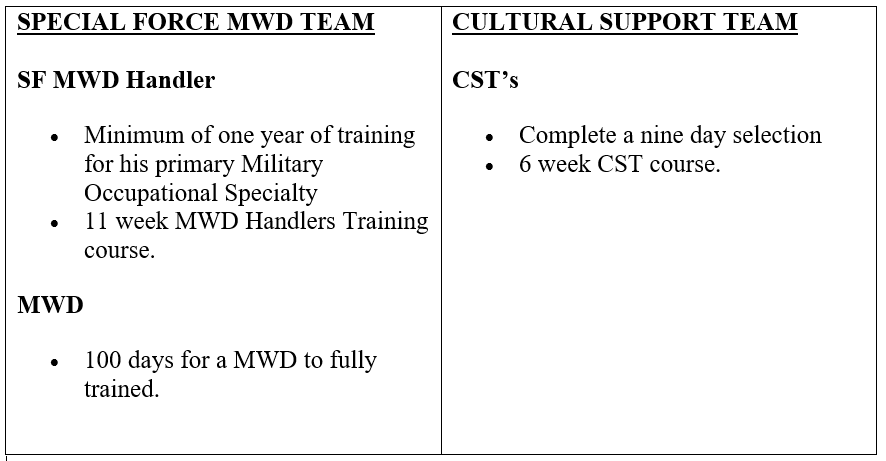
Both Military working dogs (MWD) and Cultural Support Teams are Enablers for Special Forces teams. A MWD team consists of a handler who is an 18 Series (Special Forces Qualified soldier) and a fully trained MWD.
1. Better trained.
2. MWD's can and will be the first one through the door.
3.Will go anywhere.
4. They are lighter, for when you have to carry them.
5. The enemy is terrified of them.
6. You can sleep with them.
7. They don't get mad when you put a muzzle on them.
8. Look Cool.
9. You don't get in trouble when they give you kisses.
In this bracingly honest talk, international security strategist Thomas Barnett outlines a post-Cold War solution for the foundering U.S. military that is both sensible and breathtaking in its simplicity: Break it in two. You need to take 24 minutes out of your life to listen to this mans idea's.
It goes along with my thoughts on the subject.
Every few years, the Team Sgt, usually in a fit of sadistic
glee, decides that there is a need to update the team's SOP. This is done
quite often and not necessarily because there are new members on the
team or that pre-mission training is about to begin (which usually, in his
twisted mind, is used as an excuse). More often than not, it is done
because: (a) the Team Sgt is bored; (b) the team dynamic is getting too
tense because of back-to-back missions; (c) there are Team, Company and Bn
training requirements.
The Team Sgt, with almost sociopathic delight, announces that
"in a few nights, we are going to go over our SOPs, just to make sure they
don't need to be modified. We'll hang out, drink some beer and hash a few
things out." He says this with an almost fatherly kindness.
The younger guys think this is a great idea. It is an
opportunity for them to provide some input and help out the team. The Jr.
Bravo spends the next few days pulling out the dusty SOP binder, blowing it off
and digging through the team archives, praying that the previous Bravo had
saved an electronic copy of it somewhere so he doesn't have to retype the whole
thing.
The Jr. Charlie helps out by pulling all relevant TMs and FMs,
reading through them so that when the time comes he can prove his tactical
knowledge in front of the whole team. The Jr. Echo and Delta go through
all the MOS specific information that they think everyone needs to know...
‘just like Robin Sage’.
The Seniors, with their breath catching in their throats, knees
going weak and memories (with an almostPTSD-like intensity) flash
through their heads, taking them back to the minutes prior to their first
combat mission. The Fox, upon hearing this, collapses at his desk and
with hands shaking like an epileptic with Parkinsons, opens his drawer and
breaks the seal on the bottle of Jack he put in there the morning after 'the
last time.'
The Sr. Bravo walks outside and, with fingers suddenly too fat
to dial his phone, he tries to call former teammates to reconnect with the men
who had been through the fire with him.
The true brilliance of the Team Sgt's plan is shown when he
whispers in the CPT's ear...saying things like “what a great opportunity this
will be for you” or “you can shape the team," and "like a potter
working with a lump of clay, you can form the team, make it your own." And
with the wisdom of the ancients, he says "This will be your legacy!”
The day finally comes. The Fox is at the end of a three-day
bender and the other Seniors have said their prayers to Crom, Odin or the
vengeful God of the Old Testament. They are prepared. They have said their
goodbyes and locked away all emotion and human kindness in the secret, special
box that's buried deep inside.
The CPT and younger guys are surprised when they walk in.
The fridge has been stocked, the table and chairs are all pushed to the
side, and the Team Sgt is finishing padding up the sharp corners, having
already rid the room of all edged or projectile weapons. As the Team Sgt
ascends to his desk, he passes the Jr's, who in the distant past of his mind,
thinks that they look like kids on the first day of school, arms full of
Trapper Keepers with red and black corvettes on the front, pencil boxes and a
snack in a brown paper bag.
The CPT, oblivious to what is about to happen, pulls a pen from
the plastic protector in his shirt pocket and looks up, wondering where the
head of the table is for him to sit down. Instead, he sees in the far corner,
the Hispanic Senior Charlie taking his Crucifix out, kissing it and then slowly
putting it back in his shirt. The CPT's head swivels to the other corner.
The Senior Delta swallows something out of a small bottle and chases it
with a large swig from a bottle that he is holding so tight, it looks like the
hand of a corpse is wrapped around it. He finally senses that something
is amiss when he sees the Senior Bravo squatting on a pile of tough boxes
and staring at him like a predator that's perched in a tree overlooking a
watering hole. His whole body is quivering in anticipation of the bloodbath
that is about to ensue.
The Team Sgt nods to the Fox, who, reeking of stale sweat and
alcohol, with the cold dead eyes of an executioner, slowly closes the door
and locks it with an ominous click.
Hours later the door falls open, crashing to the ground.
Dust and smoke are billowing out, so thick that all you can see is the
dim light from the empty fridge laying on its side. The light is blocked by a
hazy figure walking toward the door. The Team Sgt steps up out of the sunken
team room, putting on his leather jacket and non-DOT approved, low profile,
half helmet skullcap. As he gets on his bike, he yells back that he “will
see them in three hours for P.T.” and leaves... the only sound to punctuate the
silence of the night is the roar of his Harley, and a laugh that sounds as if
it came from the deepest pits of hell.
Washington D.C. - Following a
unanimous recommendation by the National Advisory Committee on Institutional
Quality and Integrity (NACIQI), U.S. Secretary of Education Arne Duncan today
announced the full and complete implementation of Title IX. It will end all
gender-based sports and each conference will continue to move forward with a
plan to eliminate all unnecessary gender-based barriers to college athletics.
The change is intended to ensure that the best-qualified and
most-capable person, regardless of sex, are allowed to play the sport of their
choice for their chosen college.
“If members of that college can meet the
qualifications for a job, then they should have the right to serve,
regardless of creed, color, gender or sexual orientation,” Secretary Duncan
said.
In a statement released following the announcement, President
Barack Obama praised the decision.
Duncan, laying out his plan, stated, “Any school that takes any
form of money from the government will need to cancel all gender-specific
sports and have fully integrated teams by 2018." During the press
conference, Secretary Duncan was backed up by representatives from each state's
education department.
As part of the plan, each school needs to conduct studies on
their sports' specific requirements. If those requirements preclude a certain
gender then they will have to submit a report to the Department of Education
(DOE) to justify why they are necessary.
College football
Former Adm. William McRaven, architect of the May 2011 military
raid that killed Osama Bin Laden, has been assigned as the first director of
the U.S. Sports Oversight Committee (USSOCOM) and is spearheading an effort to
get more women and minorities to play sports.
"Women make up 56 percent of the total public-university
attendance, and yet they make up zero percent of the football teams.
I think we need to grow that number,” the former four-star Admiral told an
audience of alumni.
McRaven told me during a recent interview, that he was unsure what
the expanded number would grow to. But he did note the current ratio of men to
women playing football is putting the teams at a disadvantage.
“Inherently, I know I need more females on the field," he
said. "Females have already risen through the coaching and
support-related elements of college football. But they have not
been able to break into the operational side of actually playing."
The DOE must first draw up “gender-neutral” training and
operations standards for all sport teams, and officials said they were due to
be turned in by September, 2015. Those training and operations standards will
put physical-fitness requirements for male and female candidates on
equal footing.
McRaven said, "Women athletes have already played a keyrole on the field, standing alongside male athletes in some of the most
difficult games of the year. The all-female units, known as cheerleaders,
played a key role in many conference championships. We saw the great work that
they did while working alongside college and even professional football
teams." He went on to say he was working within the state
bureaus to establish a new path for female members of universities based
closely on the female field-hockey teams.
Some of the new rules to be implemented:
Hire coaching
“advisers” from the women’s studies program to oversee recruitment,
try-outs, training, and management decisions.
If no women make
it to the team as starters, the government will conduct an audit of every
decision made throughout the process.
During the
season, the teams are required to live in open bunk rooms to build team
cohesion and unity. (Schools are required to provide separate bathing and
locker-room facilities for the female team members)
Male members of
the team are required to complete 40 hours of sexual-harassment and
rape-prevention training each season.
Secretary Duncan explained the outline to full implementation:
“First, we are going to change how college sports run their conferences."
He went on to explain that all colleges receiving public money will
have to abide by these rules, but private universities will be exempt. “To make
it fair, teams in each conference will only play like schools during the
season. Public schools will play public schools, private will play private.
They will only meet when it comes to the conference championship. Then the best
teams from each side will come together to decide the conference title.”
Senator Barbara Boxer praised the move, saying, “This is a great
moment for feminism and gender equality.” As she was leaving, not
realizing her mic was on, she leaned over and could be heard saying, “Maybe the
public conferences could just use flags instead of hitting each other. That
seems more fair.”
Next story: BREAKING NEWS—Texas Declares Independence.
What is the difference between an ODA, and a Boy Scout Troop?
Adult supervision.
It is said that war is hours of boredom interrupted by moments
of terror, which is true. There are volumes written on how to train, deal,
react go 0-60 in a heartbeat. Learning to breathe like you’re in a lamaz class.
Hell, even Ricky Bobby had to learn how to control his fear so he could drive
with a wild cougar in his car.
What hasn't been talked about as much is what happens to a man
(Yes. I said man. It's not sexist - women just aren't this stupid.) when the
monotony and boredom become too much, and a kind of euphoric insanity overtakes
you. It is a strange phenomenon because very rarely does this madness affect
only one person.
I had first heard about this affliction during the Q course. We
had some Vietnam vets come and talk to us. They told a story.
After a failed attack on their camp, they spotted an unexploded
white phosphorous mortar shell right outside the wire in the middle of their
minefield. Well, the demo guy got some C4 and went out there to blow it up.
Apparently, he had miscalculated the time fuse and it exploded while he was
trying to wind his way back through the mine field. The guys telling this story
were laughing their asses off, describing him hot-footing it around the mines
while White Phosphorous is raining down all around. I didn't get it at the
time, but I do now.
Disclaimer: I do not recommend any of these actions, even though
every single one of them was totally worth it...at the time. (Until our wives
found out, that is. Wives just don't have this child-like curiosity and wonder
at all the amazing things that are possible.) Also, I swear to everyone reading
that each story is true. Names will be hidden to protect the innocent and give
them plausible deniability when confronted by angry spouses, who may not have
heard some of these.
Afghanistan 2002
This was my entire team's first combat rotation. We were all
nervous and excited, not knowing what to expect. After a month or two we had
gotten our firebase built, and while construction was still ongoing, we weren't
being run ragged like we had been at first. We were out patrolling a lot, but
when we were back we had some downtime. That was when we came to the most
dangerous epiphany that could possibly come to guys in a foreign land at the
beginning of a brand new war. The fact that it took this long shows you how
ingrained and brainwashed we all were by the modern peacetime Army. Our
epiphany.....there is no Range Control at our Firebase.
Not only was there no Range Control, the closest adult
supervision (B team) was over three hours away, through prime ambush areas over
spine crushing roads. You don't really see the insanity at the time. It is only
when looking back through the hazy lens of time do the "what the
fucks" come.
I think the first time the insanity hit, I was standing on the
edge of our Firebase looking down, far below, across our DZ to where we had set
up our heavy weapons range. The range was on top of a deep cut that was not
only a river bed, but also acted as a road. Across the stream/road was a tall
ridgeline that ran parallel to our fire base. We would shoot our heavy weapons
over the road and use the ridgeline as our impact zone. Right next to the
firing line was the outline of an old compound we called the ruins. All that
was left was the typical Afghan mud wall, about 3 feet high and about 2 feet
thick.
The insanity hadn't completely taken a hold of me yet so I
couldn't quite believe what I was seeing. I saw three of our guys shooting the
60 mm mortar, similar to this. They
were standing about 15-20 meters from the ruins and seeing if they could get
the round to land inside. They were holding the tube straight up and shooting
it. Every once in a while they would shoot it, and a few seconds later they
would all dive for cover and the round would hit danger close. They would get
up, brush the dirt off and do it again.
In their defense, they got so they could set up right next to
the compound and make it land inside...almost every time.
A few days later my Bravo was down there again, this time by
himself doing the same exact thing, except this time he was using his 203
grenade launcher. By now, I was full in the clutches of this dangerous malady,
so of course I went down and joined in. If you've never shot one, if you pay
real close attention when you shoot, you can watch the grenade fly.
Trying to get a 40mm grenade to land 15 meters away is not easy.
The wind, rotation of the earth, tides, the moon's gravity and global warming
all come into play. Well, sometimes you would lose sight of it, or you would
see it coming down where you're pretty sure it will be too close, so it then
becomes necessary for you to throw yourself to the ground, in the opposite
direction from where you think it might be heading (stupid global warming). But
practice does make, if not perfect, at least less shitty, so by the end we
getting most of them right in the ruins.
Sometimes it's not insanity that hits you, but a really
"funny" idea on which you probably could have done a better
cost-benefit analysis. As a Fox, I now know to look for 2nd and 3rd order
effects, but sometimes a lack of critical thinking on your part makes your
hilarious joke less funny for you, but infinitely more funny for everyone else.
That happened to me on my third trip.
We were right next to FOB Salerno who had a medevac unit located
there. Our medics had built a good relationship with the pilots, and they would
come over and conduct training. Many times they needed to go pick someone up,
so they would fly over and pick our 18Ds up to help out, so it was not uncommon
to see the helicopters sitting out there on the airfield. I got to know the
pilots and would sit around and bullshit with them.
Well, one afternoon I was out doing PT running around the airfield,
in nothing but ranger panties, of course. I was at the end of the runway
heading toward them as they were taking off. They were going to fly right over
me so I quickly turned around and dropped my shorts, laughing at how clever and
funny I was. Apparently, the pilot thought I was funny too, because he brought
the helicopter to a hover...directly over me.
Even though I couldn't see due to the fact that I was blind in
the middle of a tornado and every orifice was completely covered in dirt, I
just knew they were laughing.
I wanted to write a short article on some of the dangers of
rapport building and some things that you need to watch out for. I like to use
the example of democracy in the Middle East. We can’t expect whatever form of
democracy other people choose to be exactly like ours. It’s a foolish notion
and one destined for failure. You have to find a middle ground that takes into
account that countries history, culture and social norms.
When living and working with a different culture, building
rapport, fighting and dying shoulder to shoulder with them, it is easy to
become emotionally involved. It is easy, especially when they are honorable and
likable, to find yourself assimilating with them. As I stated in The
Importance of Rapport, the best advice I
ever received is to never go more than 49% native. My first team sergeant
understood rapport, but also the dangers that could come. It’s a fine line to
walk, as is everything dealing with Foreign Internal Defense (FID) (especially
during combat). Combat creates a bond, a brotherhood that is hard to break.
Many soldiers learn quickly to compartmentalize, and SOF are
experts at it, but from my experience Special Forces are able to do it better
than most.
Compartmentalized
mindshave diversified personalities which enable them
to behave differently and appropriately in a variety of situations such that
they can behave like a boss or worker on the job, a parent and/or spouse and/or
grown child at home, a teammate on a sport, etc. To be competent in each area
they are said to be good at “having boundaries” such that one role does not
blur into another.
One of the challenges however of being highly compartmentalized
is that over time, people may lean more and more into those compartments where
they feel most competent, capable and confident. That can cause other
compartments to either atrophy from disuse or in some cases never develop in
the first place. Over time these people can appear to be more like “human
doings” that don’t feel particularly present as people even as they appear
quite competent in a particular function. Think of IT instead of HR.
I don’t know if it is a psychological trait that is looked for,
but I do know that training quickly refines and expands it. The hard training
that is involved starting at selection (and honestly, it never stops) is part
of the mental selection and mental training. The ability to separate the pain
and discomfort, and to push forward in spite of it, is just one way that is
used to find people who have the ability to create those compartments or can already
do it. If a person can’t do this effectively they will either quit or be booted
out at some point during the training.
The reason I saySpecial Forcesare better
at being able to do this is because they are required to have more
compartments. There is the family, deployment, team, group, army, and America.
They also have to be able to fully immerse themselves with whatever local unit,
tribe, sect, they happen to be working or interacting with they are working in
Afghanistan or Iraq. Between combat deployments they are still conducting JCETs
and non-combat FID in multiple foreign countries. Each of these examples has a
different compartment, and each compartment has only what is needed to succeed
in that one situation.
To understand how significant these compartments are, I will use
myself as an example. Whenever I deployed (and there were a lot of them), I got
into the habit of asking my wife and kids to drop me off and leave. I didn’t
want them to wait with me or hang out like a lot of other families did. They
would drop me off at the curb and we would say our goodbyes. I would watch them
drive away, then go in and hang out or bullshit until it was time to load the
plane.
Standing on the curb watching them drive away was the beginning
for me. It was part of the process I developed to help me switch compartments.
After the plane took off, I would take anAmbienand sleep
for about four hours When I woke up the family compartment was locked up tight
and the deployment compartment was open and ready to go. I would only open the
family compartment when it was safe, or when I was on the phone talking to
them. It was never opened fully, but cracked just enough to give me what I
needed to talk to them. As soon as I hung up it was slammed down and locked
back up. It was never opened fully until I walked back into my house.
And as I’m writing this and thinking about it, I have to admit
that the family compartment never really completely opened while I was in.
Knowing I had another deployment coming up, or could be sent somewhere with
very little notice. This forced me to keep a tight hold on it so it could
easily be shut on the next trip.
Some compartments necessitated switching from one to the other
in the blink of an eye; others took time to prepare. In Kosovo, our primary
mission was to act as liaisons between the locals and the U.S. General in
charge of the American sector. We walked around in only a uniform and concealed
pistol and had to be able to go from friendly conversation to sensing a threat
and drawing in an instant. Some people refer to that as “flipping a switch,”
which is a good analogy of going between times of quiet to sudden
violence. 'Flipping a switch', while a good descriptive phrase, doesn’t change
the fact that those situations required two very different compartments. If you
couldn’t switch fast enough, you died.
People who can’t flip that switch either became too trusting or too
friendly with locals, and forget exactly where they are, or they can’t relax
and be in the moment. They would subconsciously perceive everyone as a threat,
which the locals could easily sense. This created a lack of trust, which
prevented the rapport from developing.
The point is that when you can compartmentalize, you are able to
give 100% of your 49%(Naked gun 50/50 chance) to the people that you
train and work with. This allows you to be better able to build that trust
without losing yourself. You can keep the American and the U.S. Soldier
compartment safe and switch when needed.
Colonel Mike Copenhayer, while not technically an “operator,” has spent a lot of time in SOF units, most likely screwing up awards, losing promotion packets, and generally making it as difficult as possible for the guys on the tip of the spear to do their job.
As the personnel officer who has been the J1 at the Joint Special Operations Command and G1 at the US Army Special Operations Command, he is part of the bureaucracy that has made life exceedingly difficult for a huge percentage of all Special Operations Force soldiers.
Not satisfied with only a mere “huge percentage,” Colonel Copenhayer sought to go further by writing “The Integration of Minorities into Special Operations: How Cultural Diversity Enhances Operations” while attending the United States Army War College.
First off, I
apparently wasn't clear enough in my first article. SF = SPECIAL FORCES/GREEN
BERETS ONLY!!!!
After reading some
Facebook comments, there seems to be a couple of other misconceptions. Please
check out the US Special Operation's Command (USSOCOM) structure. This is an excellent
high-resolution organizational chart that shows each and every unit under
USSOCOM and where they fall. SF is not under JSOC, and I chose not to write
about Delta Force/CAG because I was never in that unit. It is not my place to
explain them.
Because of our two
recent conflicts, people tend to think that FID is the same thing as COIN and
that anyone can do it. While many times there is a counter insurgency reason to
conduct FID, there doesn't have to be.
During COIN, FID is a
tool that can be used to better prepare Government Forces, whether military,
law enforcement or helping a staff even up to the Cabinet level. In active war
zones, FID can be used to create a unit from scratch, like in Iraq, or used to
bolster the forces already there. During peace time, FID is used to conduct
training specifically asked for by the Host Nation (HN).
In my previous article, I explained why not everyone can do COIN and
many of the same lessons apply to FID. The unit conducting it must have an
understanding of cultural differences and the ability to work with units that
run the gamut, from barely off the farm to highly trained CT forces.
As with UW, knowing
the language is important. There are many people who can do great things, but
get them in front of a group of people who aren't American, and attempt to
teach them how to do even the basics, and they either choke, get frustrated or
pissed off. Whoever is conducting the training needs to be able to know what
instructional method will work the best, and then be able to articulate that
into another language and culture, many times without the use of PPT. Acting
like a Drill Sgt screaming at them will most likely do the exact opposite of
what you intended. Let’s be honest, if it was easy, the Coast Guard would be
doing it.
Due to the rampant
misunderstanding of Foreign Internal Defense (FID), it has been disrespected
and mocked by the DA side of SOF, because it isn't as “sexy.” Ironically, it
can be argued that FID is the most important mission in the U.S. global
arsenal, especially since the wars are winding down. FID is a major tool that
the U.S. has for fighting and preventing future wars or conflicts. Other SOF
units are beginning to see this, which is why there has been an increase of
improving UW/IW/FID capabilities.
But it is so much more
than teaching people to wipe their ass and march in a straight line.
Foreign Internal Defense
Participation by
civilian and military agencies of a government in any of the action programs
taken by another government or other designated organization to free and
protect its society from subversion, lawlessness, insurgency, terrorism, and
other threats to its security. Also called FID. (JP 3-22)
I feel that FID should
be broken down into two sub-categories, "Peace Time FID" and
"Combat FID."
Combat FID
Special Forces/Green
Berets have been going into combat with units that they have trained since they
were created. Laos, Vietnam, El Salvador, Afghanistan and Iraq to name just a
few. Many of the units had never previously existed and in fact were stood up
by ODAs, They were created, trained, and when they are sufficiently trained, conduct combat ops.The ODAs mentored them through multiple deployments year after year. Many times SF soldiers made repeat trips and worked with the same FID partners,
Lara Logan in Iraq
Whether you are
talking about the Nungs or Rhades in Vietnam, or the multi ethnic elite ICTF in
Iraq, the basics are all the same.
US/ICTF firefight
in Iraq
In the case of
building a professional capability into the HN military, the final goal is for
them to conduct operations on their own, with no U.S. forces involved. ICTF Unilateral ops(if you don't like haji music, turn the
volume down).
During the early stages, the Special Forces Soldiers will conduct all phases from training, planning, rehearsals and they will be in charge on the ground and lead the combat operation. As the HN force becomes better trained, the Special Forces soldiers will step back into a more advisory role, but still be with their FID partners through every phase from planning, to boots on the ground. They are with them, shoulder to shoulder with the HN, fighting and dying next to each other while acting as a liaison between the HN and U.S. assets. ( CAS, artillery, ISR or medevacs)
The end state of
Combat FID is that you are attempting to work yourself out of a job. My
crowning achievement with combat FID happened in 2008. My team was working in
Baghdad with the 36th Commando Bn, which is a part of the Iraqi Special
Operations Force (ISOF). We had received word that there was an HVT that the
CFs had been trying to get for years, but he was constantly moving between Iraq
and Iran, never sleeping in the same place for two nights in a row. This cat
was slippery. We found out that he was going to be staying at the Baghdad
hospital and submitted a CONOP; ready to roll when it was time. Our plan went
all the way up to the General's staff where it was denied, because the target
was in a hospital and it wasn't worth the potential PR nightmare if something
went wrong.
As the 18F, I went to
my Team Leader and Team Sgt after they had told me, and I made the
recommendation to unleash our barbarians on the world, with no adult
supervision. It was a risk because it had already been denied, but in '08 ISOF
was coming into their own, and they had their own ROEs and launch requirements
outside of the U.S. Chain of Command. As long as those conditions were met,
they didn't need U.S. permission to go. My leadership talked it out and agreed.
We got the word and
went down to the Bn leadership and briefed them on the mission and the
situation. I told the commander that this was a chance for him to highlight the
capabilities of his unit, police up a very bad man, and everyone would know
that his unit was able to do this mission with no American support. (See what I
did there? Because I had worked closely with them, I knew their capabilities,
strengths, weakness and insecurities. Even though he was nervous going out
without us, I knew exactly what buttons to push and what kind of motivation he
needed to go out and get the guy that I wanted them to get. See The importance of rapport)
It was a completely
unilateral Iraqi mission. We advised them on the planning and helped with Intel,
but when they left the compound it was with a convoy of about 20 trucks,
personally led by the Bn Cdr. It was a nervous night for my team leadership and
me. If things went sideways, there was a very good chance that the hammer would
come down on us. Even if you are completely right and justified, if a 3-star is
pissed off, there's no ballistic protection that will save you.
A few hours later they
came back, and I watched the Commando Bn CDR escort his prisoner into the
detention facility. I could see the pride for his men even though he was trying
to keep his face professional. They infiltrated into the gated hospital,
surrounded the building this motherfucker was hiding in, and captured him
without firing a shot or doing any significant damage to the hospital. It was
funny because, even though I wanted to go out myself and be on the target with
them, I had the exact same pride for the boys that he had.
Peacetime FID
Peacetime FID is best
utilized when the HN agencies that are involved are already somewhat capable
and are asking for U.S. assistance to get training in basic tasks; or when they
are requesting specialized advanced training, usually by USSOF conducting Joint
Combined Exchange Training (JCET). They are normally requested and approved
through the Department of State, who then pass it to DOD.
When FID is requested
and approved, it is usually in support of the overall strategic goals of the
United States Government, because it provides a friendly Government
with the capabilities to handle any internal or external threats with
minimal direct U.S. involvement, while maintaining legitimacy of the Government
and the respect of the local populace.
Peacetime FID is not a
tactic for those who demand immediate gratification. It is a tool to be
developed over many years, and used to create relationships between individuals
and units at the operational level. The trust and respect that is built takes
time, but when successful, it allows the U.S. to have not only regional experts
who have been there many times, but also locals who have had good experience
and look favorably on the U.S. When Peacetime FID done right, it prevents the
need to send large conventional forces into hostile action because the
situation deteriorated due to the inability of the HN military or Security
Forces to handle it.
This is a great 40 min video showing SF working with the ANA Commando's and Afghan Special Forces.
Lesson 3 will finally answer the most asked question on the internet:
“Who is better, SEALs or SF, Rangers or SF, any SOF unit, U.S. or Coalition vs.
SF”... just kidding, I’ll answer it now. The answer is, and always will be, the
Special Forces/Green Berets. (Although I may not be completely impartial.)